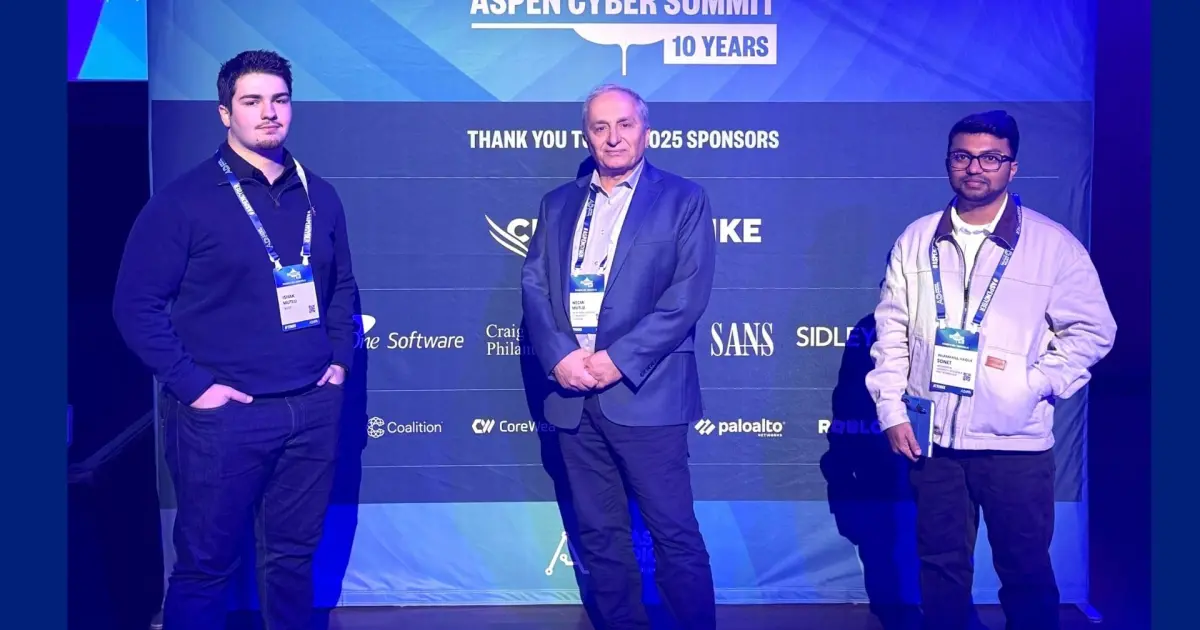
The 2025 Aspen Cyber Summit—widely regarded as the nation’s premier annual gathering on cybersecurity and technology policy—brought together influential leaders from government, industry, and academia. This year, WUST’s Dr. Mutlu, along with SOC Lab Assistants Injamamul Haque Sonet and Ishak Mutlu, proudly attended the summit on behalf of the Washington University of Science and Technology, representing our growing commitment to cybersecurity education and innovation.
One of the most anticipated sessions, “Building the National Cyber Strategy,” featured two distinguished speakers:
- Sean Cairncross, White House National Cyber Director
- Kevin Mandia, Founder of Mandiant; General Partner, Ballistic Ventures
This discussion explored the Trump Administration’s vision for the next National Cyber Strategy, the essential role of public-private partnerships, and the challenges shaping the next decade of cyber defense.
Streamlining the Regulatory Environment
Director Sean Cairncross emphasized the administration’s active effort to simplify and modernize cybersecurity regulations across every sector. He stressed that industry input is critical, noting that organizations are closest to their own operational friction points.
“We’re fully committed to streamlining—sector by sector. But industry leaders need to give us a clear list of what isn’t working. I do love a good list,” Cairncross remarked.
This collaborative approach seeks to identify:
- Regulatory pain areas
- Bottlenecks
- Inefficiencies that slow cyber readiness
WUST attendees noted that this messaging aligns with the broader national push for a more agile, responsive cybersecurity ecosystem.
Accelerating Government Technology Adoption
A recurring theme was the need for government systems to adopt technology at the pace of innovation. Historically, by the time federal agencies complete procurement processes, new tools have already become outdated—and vulnerable.
To address this, the administration is:
- Launching pilot programs for emerging technologies
- Working closely with national laboratories
- Accelerating procurement timelines
- Coordinating across agencies such as OMB, DFW, and others
The goal is to move fast, but not blindly—ensuring agencies and partners are prepared, informed, and included in every step. Dr. Mutlu and the SOC Lab team observed strong enthusiasm among summit participants for this shift, with many noting it is long overdue.
AI, Cyber Threats, and the Future of Defense
Kevin Mandia delivered a compelling prediction: within the next five years, most cyberattacks will be launched by autonomous AI agents. Because criminals adopt new technologies more quickly than defenders, organizations must prepare for cyber threats that operate at machine speed.
Mandia explained that future enterprise defense will resemble sealing compartments in a submarine—instant isolation of breaches to prevent widespread damage. He also highlighted the staggering number of stolen credentials circulating online—over 2 billion compromised accounts—which attackers can easily automate and exploit. Director Cairncross reinforced that AI security must be built into innovation, not added after the fact. This will be vital for maintaining U.S. leadership in advanced technologies. For the WUST SOC Lab team, this reinforced how essential hands-on AI-driven cybersecurity training will be for students entering the field.
Developing the Next-Generation Cyber Workforce
Another major takeaway was the urgent need to expand and modernize the U.S. cyber talent pipeline. The speakers pointed to Israel’s world-renowned model that combines:
- Startup culture
- Venture capital incentives
- Structured training programs
- Early exposure to real-world problem solving
The proposed U.S. approach includes establishing a U.S. Cyber Academy by leveraging existing federal and academic resources—without requiring new authorities or new funding.
The vision is to produce graduates who understand:
- Innovation
- Cyber defense
- Tech culture
- Public service
WUST’s participation in the summit reinforces the university’s commitment to preparing students for these emerging roles—especially through programs such as the SOC Lab, Cybersecurity Club, capstone projects, and hands-on competitions.

Dr. Necmi Mutlu
IT Lead Faculty
2900 Eisenhower Ave, Alexandra, VA 22314
Email: [email protected]
Web: www.wust.edu